
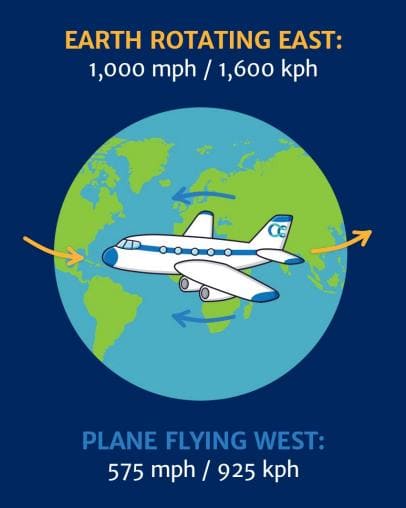
Is Earth Really Spinning Under Your Airplane? This video takes a bold and focused approach to questioning the spinning globe narrative by examining one clear, everyday example: roundtrip flights between Atlanta and San Diego. Using simple math and observable reality, it challenges the mainstream belief that the Earth is rotating at 870 mph. Here’s the issue: If the Earth is really spinning eastward at such a high speed, then flights going east (with the rotation) and west (against the rotation) should not take the same amount of time. Yet, in reality, they do — roughly 3.45 hours in both directions. This glaring contradiction is swept under the rug by official explanations, which rely on vague, unobservable principles like “conservation of momentum.” The video points out the flaws in that argument. Once a plane leaves the ground, how can it maintain the Earth’s rotational speed? Air resistance, gravity, and engine thrust should logically override any “inherited” momentum. And if the atmosphere is supposedly rotating with the Earth, dragging planes along — how exactly does light, low-density air manage to push a 500,000+ pound plane? The comparison to a boat floating down a river falls flat when you realize air isn’t water. The analysis even challenges the idea that planes are secretly flying at over 1,400 mph — something never mentioned by pilots or flight crews. Instead, the only speed consistently referenced is the airspeed or ground speed of 550 mph. Nothing more. The conclusion is simple and powerful: the Earth is not spinning. The near-identical flight durations make far more sense on a stationary, flat Earth. This doesn’t require convoluted theories or imaginary forces — just observation, logic, and common sense. Why complicate the truth when the simplest explanation — that the Earth is still and unmoving — fits the evidence right in front of us?
Transcript
let’s carefully analyze a specific
0:03
easily understood modern-day scenario
0:05
that questions the widely accepted
0:07
belief that the Earth is a spinning
0:09
globe by examining one example in detail
0:13
we aim to present compelling evidence
0:15
that the Earth is in fact stationary
0:18
instead of briefly touching on multiple
0:20
contemporary examples that may lack
0:22
overall depth and impact we will
0:24
concentrate on one particular example
0:26
that clearly evidences the Earth’s fixed
0:29
and stationary nature our primary
0:31
objective is to cast significant doubt
0:34
on the credibility of the mainstream
0:36
narrative endorsed by NASA and the
0:38
conventional principles of flight
0:40
dynamics that posit the theory of a
0:42
rotating spherical Earth through this
0:45
detailed examination we aim to reveal
0:47
how easily the public continues to
0:50
accept official explanations without
0:52
substantial scrutiny we will refute
0:55
these commonly accepted explanations
0:57
highlighting their inherent flaws and
0:59
lack of plausibility when examined
1:01
closer in our analysis we will focus on
1:05
roundtrip flights between Atlanta
1:07
Georgia and San Diego California these
1:10
coast to coast flights typically cruise
1:12
at an average speed of 550 mph and have
1:16
an average flight duration of
1:18
approximately 3.45 hours assuming no
1:21
wind or turbulence 1900 m / 550 mph
1:27
equals 3.45 hours this should raise
1:31
obvious and critical questions at this
1:34
latitude considering that the Earth is
1:36
said to rotate west to east at 870 mph
1:40
beneath the plane during flight how do
1:43
flights in both directions report nearly
1:46
identical flight times in other words if
1:49
a plane flies at a constant speed of 550
1:52
mph between these two cities how can the
1:55
flight times be the same in both
1:57
directions given that the Earth is said
1:59
to rotate from west to east moving with
2:02
the plane in one direction and directly
2:04
against the plane in the other examining
2:07
closer on an eastbound flight from San
2:10
Diego to Atlanta the Earth’s rotation
2:13
moves in the same direction as the
2:15
aircraft conversely on a westbound
2:17
flight from Atlanta to San Diego the
2:20
Earth rotates in the opposite direction
2:22
to the aircraft’s travel these opposing
2:24
dynamics present significant challenges
2:27
that become apparent upon closer
2:29
examination in our first scenario when
2:32
heading east once our plane is airborne
2:35
and detached from the Earth’s surface it
2:37
leaves San Diego heading for Atlanta the
2:40
Earth is said to rotate eastward below
2:42
our flight with us at 870 mph while our
2:46
plane eventually reaches its own
2:48
independent cruising speed of 550
2:52
mph how then will our plane ever arrive
2:55
in Atlanta to clarify our plane’s
2:58
cruising speed of 550 mph is 320 mph
3:03
slower than the Earth’s rotational speed
3:05
of 870 mph beneath us during our flight
3:09
as the Earth’s direction of spin and our
3:12
plane are heading in the exact same
3:14
direction and latitude in our second
3:16
scenario as we begin our return flight
3:18
to San Diego from Atlanta the dynamics
3:21
change entirely further complicating the
3:24
official explanations as to why the
3:26
flight times in both directions are
3:28
almost identical once the aircraft lifts
3:31
off and disconnects from the Earth’s
3:33
surface San Diego is now approaching our
3:36
plane at a speed of 870 mph due to the
3:39
eastward spin of the Earth bringing San
3:41
Diego directly to us while
3:44
simultaneously directly approaching San
3:46
Diego our destination city at an
3:48
independent flight speed of 550 mph our
3:52
plane and San Diego are now closing in
3:55
on each other this should in reality
3:58
significantly reduce our flight time as
4:00
the two combined speeds effectively
4:03
create a far faster convergence speed of
4:06
1,420
4:08
mph the actual flight duration should
4:11
now be shortened to just 1.33 hours
4:14
rather than the actual 3.45 hours
4:17
observed daily for this specific flight
4:20
1,900 m / 1420 mph equals 1.33 hours the
4:28
fact that the actual daily flight times
4:31
between these two cities are almost
4:33
identical in both directions assuming no
4:35
wind or turbulence should clearly reveal
4:38
that the Earth does not rotate but
4:40
rather rests
4:42
the first counterargument within the
4:44
official narrative attempts to explain
4:46
the identical flight times between these
4:48
opposing scenarios by invoking the
4:50
principle of conservation of momentum a
4:53
fundamental concept in physics according
4:56
to this explanation when our plane flies
4:58
from San Diego to Atlanta it retains the
5:01
eastward spin imparted from the Earth’s
5:03
rotation at takeoff which is
5:05
approximately 870 mph at this latitude
5:09
the plane is then said to add its own
5:11
separate cruising speed of 550 mph to
5:14
this conserved momentum therefore the
5:17
plane’s total air speed is said to be a
5:19
combination of the 870 mph imparted by
5:23
the Earth’s rotation at takeoff and its
5:25
own cruising speed of 550 mph in effect
5:30
the plane is then alleged to be moving
5:32
at a total air speed of
5:34
1,420
5:36
mph 870 mph plus 550 mph equals 1,420
5:44
mph how does an airplane once airborne
5:47
and detached from the ground maintain
5:49
the momentum it is said to inherit from
5:51
the Earth’s rotation at takeoff during
5:53
its flight to Atlanta consider a
5:55
baseball being thrown from west to east
5:58
similar to an airplane does it continue
6:00
on its initial trajectory unchanged or
6:03
does it begin to arc towards the ground
6:05
due to gravity and air resistance almost
6:08
immediately conventional wisdom tells us
6:11
that a baseball will indeed begin arcing
6:14
downward would an airplane not be
6:16
subject to these same principles the
6:19
continuing argument to this states that
6:21
an airplane maintains its initial
6:23
velocity inherited from the earth’s
6:25
rotation at takeoff through continuous
6:27
propulsion from its engines which
6:29
counteracts any slowdown however we must
6:32
remember that once an airplane leaves
6:34
the ground it is no longer propelled by
6:36
the force of a spinning earth
6:38
additionally air resistance acting
6:40
against the plane increasing with speed
6:43
continually works against any initial
6:45
velocity boost provided by the Earth’s
6:47
rotation the net result is that once
6:50
airborne and disconnected from the
6:52
ground the airplane’s forward motion
6:54
relies solely on engine thrust to
6:56
maintain the required speed of travel
6:59
this is because any initial contribution
7:01
from the Earth’s rotation at takeoff is
7:03
soon negated by continual air resistance
7:07
to further support this it is important
7:09
to recognize that passengers on
7:11
commercial flights are never informed
7:13
that they are traveling at speeds
7:14
upwards of
7:16
a,420 mph to counteract the Earth’s
7:19
rapid rotation during some flights we
7:22
never hear relative motion mentioned or
7:24
referenced at any point past or present
7:27
concerning commercial flights the only
7:29
speed ever mentioned is the ground speed
7:31
which is typically around 550 mph or
7:35
slightly higher with a tailwind it
7:37
should be quite apparent that the plane
7:39
maintains an air speed and ground speed
7:41
of 550 mph in both directions which
7:45
supports the consistent flight times
7:47
observed for these daily flights
7:49
aligning perfectly with the scenario of
7:52
a non-rotating Earth beneath it a
7:55
stationary Earth logically explains
7:57
identical flight times in both
7:59
directions eliminating the need for the
8:01
adjustments and complex explanations
8:04
required for a spinning Earth in summary
8:07
the concept of conservation of momentum
8:10
proves ineffective in our scenario once
8:12
the plane becomes airborne although the
8:15
airplane would theoretically inherit an
8:17
initial burst of momentum from a
8:19
rotating Earth at takeoff this momentum
8:22
is quickly negated by air resistance and
8:24
gravity once airborne the plane operates
8:28
as an independent entity with external
8:30
forces continuously counteracting any
8:32
inherited momentum effectively
8:34
nullifying the predicted effects of the
8:37
conservation of momentum principle the
8:40
second common counterargument suggests
8:42
how gravity and friction cause earth’s
8:45
atmosphere to rotate in conjunction with
8:47
the earth this argument states that
8:49
airplanes are transported not only by
8:52
the previously mentioned conservation of
8:54
momentum but also by the air which is
8:56
itself influenced by earth’s rotation it
8:59
implies that the earth its atmosphere
9:02
and the airplane move together as a
9:04
single system according to this claim in
9:07
our scenario the airplane maintains the
9:10
870 mph speed it initially gains from
9:13
the Earth’s rotation thanks to
9:14
atmospheric cohesion this cohesion is
9:18
alleged to help the airplane preserve
9:19
and maintain the speed inherited from
9:21
the rotating Earth at takeoff
9:24
subsequently the airplane’s engines are
9:26
said to provide the additional thrust
9:28
needed to reach the higher speeds which
9:30
are required for progress towards
9:32
Atlanta for this theory to be valid it
9:35
must account for the scenario where an
9:37
airplane turns off its engines
9:39
mid-flight in such a case the airplane
9:41
would need to be significantly carried
9:43
along by the atmosphere thereby
9:45
supporting the claim of the atmosphere’s
9:47
significant role in this case however
9:50
common understanding tells us that much
9:53
like a thrown baseball an airplane in
9:55
this scenario would immediately begin to
9:57
descend this illustrates that
9:59
atmospheric drag does not significantly
10:02
influence its forward momentum to help
10:04
sustain its flight next the idea that
10:07
atmospheric drag a form of cohesion
10:10
could attach to and sustain the momentum
10:12
of a commercial airplane weighing
10:14
between 500,000 and a million pound by
10:17
dragging it along is beyond difficult to
10:20
accept
10:21
such theories and explanations seemingly
10:23
require us to disregard logic common
10:26
sense and reason to consider them
10:28
feasible the concept of atmospheric drag
10:31
is quite often compared to a boat being
10:34
carried by a river’s current however
10:36
this analogy quickly falls short upon
10:38
closer examination recognizing that
10:41
water has significant density and
10:43
cohesive properties that air simply does
10:46
not match given air’s considerably low
10:49
density and minimal cohesive potential
10:51
the idea that it can mimic the cohesive
10:53
behavior of water adhering to and
10:56
carrying along an extremely heavy
10:58
compact object like a commercial
11:00
airplane is fundamentally flawed to
11:03
demonstrate a valid example of
11:04
atmospheric drag consider the observable
11:07
phenomenon where a cigarette smoke
11:09
appears stationary and aligned inside a
11:12
moving car with closed windows and
11:14
inactive air vents this occurs because
11:17
both the air inside the car and the
11:19
cigarette smoke share similar properties
11:21
of density and buoyancy as a result when
11:24
the car moves the entire body of air
11:27
inside including the smoke moves
11:29
uniformly with it this is a valid
11:32
example of atmospheric drag now consider
11:35
a scenario where a ball is tossed upward
11:37
inside a moving car if the brakes are
11:40
abruptly applied while the ball is still
11:42
in midair the ball would trend forward
11:44
toward the dashboard or windshield this
11:47
phenomenon demonstrates that the
11:49
atmosphere inside the car does not
11:51
significantly adhere to the ball and
11:54
slow its forward momentum to match the
11:56
rapidly decelerating vehicle’s internal
11:59
atmosphere even if there is a slight
12:01
effect it is far too negligible to be
12:04
noticeable
12:05
this example with a ball illustrates
12:08
that low density air does not
12:10
substantially adhere to or considerably
12:12
affect denser objects this observation
12:15
directly challenges the notion that air
12:18
can adhere to a denser object such as an
12:20
airplane and significantly contribute to
12:22
dragging it along in a moving atmosphere
12:26
despite this evidence we are expected to
12:28
believe that an airplane with its
12:30
considerable density and weight can be
12:33
effectively carried along by atmospheric
12:35
drag maintaining the momentum acquired
12:38
from the Earth’s rotation at takeoff
12:40
while atmospheric drag might have a
12:42
brief effect it is not substantial
12:44
enough to significantly influence the
12:47
behavior in our airplane scenario thus
12:49
rendering it a negligible factor
12:52
it is surprising to see even prominent
12:55
highly intelligent individuals
12:57
attempting to justify atmospheric drag
12:59
and conservation of momentum as
13:01
plausible explanations for consistent
13:03
flight durations observed in our two
13:05
flight scenarios it would not be
13:08
surprising if quantum mechanics were
13:10
introduced at some point in the future
13:12
as yet another means to further perplex
13:14
and confuse us our tendency to readily
13:17
accept scientific explanations or
13:20
passively conform to official narratives
13:22
highlights an enduring pattern within
13:25
society revisiting the application of
13:27
AAM’s razor to our flight scenarios
13:30
reveals that the simplest explanation is
13:33
clearly a stationary non-rotating Earth
13:37
this model plausibly explains why
13:39
flights between the east and west coasts
13:42
have nearly identical times with no need
13:44
for complex explanations adjustments or
13:47
fixes required by a spinning Earth model
13:51
the official explanation from NASA and
13:54
the field of modern flight dynamics
13:56
attempting to account for these
13:57
identical flight times despite an
13:59
allegedly spinning Earth is entirely
14:03
untenable