
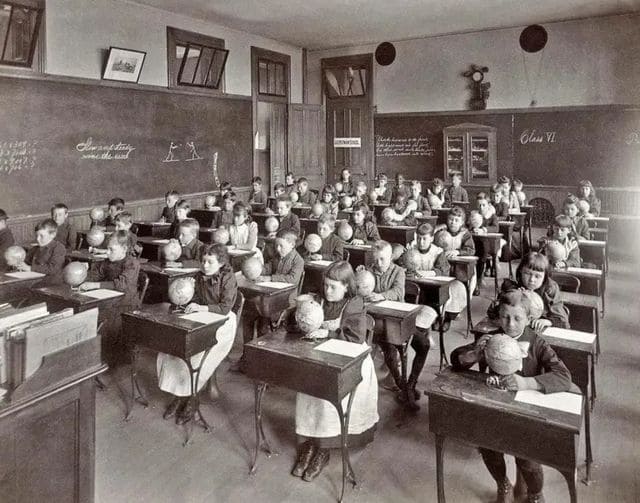
NASA Funds Program To Indoctrinate Kids Towards Globe View Study of how to make kids conform to the globe ideology NASA vs. The Children: A Flat Earth Tragedy Once upon a time, in classrooms across Greece and America, innocent children looked out their windows, used their eyes, and—gasp—thought the Earth was flat. Naturally, this posed a catastrophic threat to the scientific orthodoxy. Enter the National Science Foundation, a proud arm of NASA, wielding its mighty grant money like a globe-shaped hammer. In 1990, a study was launched—not to understand what kids thought, but to correct them. Because clearly, if 5-year-olds think the Earth is flat, the only logical response is to stage a full-scale psychological reprogramming operation. The mission? Make these round-Earth heretics conform to the sacred doctrines of sphericalism. The kids, bless them, described the Earth as flat, stationary, and with an actual edge (where you might fall off if you’re not holding on tight enough). But instead of giving them a gold star for observational accuracy, the researchers labeled them “naive” and got to work reshaping their tiny minds with styrofoam balls and carefully-worded questions. Responses like “the Earth is a circle” or “you could fall off the edge” were treated like dangerous propaganda, while “sphere” was praised as the correct answer—because nothing says “critical thinking” like learning to repeat what your textbook says. To make matters more educational, the study even modified the questionnaire for Greek kids—just in case cultural variation got in the way of spherical conformity. Turns out, whether in Athens or Arkansas, kids start off flat and have to be rounded out by the system. In the end, NASA achieved its goal: a new generation of globe believers. Sure, they had to override children’s natural perceptions, but hey—what’s a little mental gymnastics when you’re defending the honor of a spinning space ball?
Transcript
okay the work upon which this
0:13
publication was based was supported in
0:15
part by grant
0:17
number NSF now for those don’t know it
0:21
says it plain as day National Science
0:22
Foundation the National Science
0:25
Foundation is an arm of
0:29
NASA let me say that again the National
0:32
Science Foundation is an arm of
0:36
NASA so this was a NASA
0:39
grant conducted
0:42
there was a NASA grant issued for this
0:44
specific
0:46
study so that NASA could get an
0:49
understanding
0:51
of how they were going to affect the
0:56
psychology of our future
0:59
generation now the paper was put out in
1:02
1990
1:04
so if you have any children that were
1:07
born in the
1:09
80s you can
1:12
Bet that if you start researching
1:17
the policy changes
1:21
in preliminary middle school and high
1:24
school education the curriculums you can
1:27
guarantee that from say 2000 on when you
1:32
compare the
1:34
curriculums they NASA had the
1:36
curriculums changed and the textbooks
1:38
changed to reflect the worldwide view
1:41
they need our future
1:45
children to agree
1:48
to let’s go to the abstract
1:51
here in this
1:55
report we present the results of a
1:57
cross-cultural study on children’s
1:59
knowledge about the shape gravity
2:01
movement and location of the earth and
2:04
about the day night cycle the subjects
2:07
of the study were elementary school
2:09
students from
2:10
Greece numbering 90 and equals 90 that’s
2:14
what it means 90 students and the United
2:17
States 60 students the results of the
2:21
study showed that the children in both
2:23
samples constructed similar initial
2:26
concepts about the earth and went
2:28
through similar steps in the process of
2:30
changing these concepts to make them
2:34
conform to the currently accepted
2:37
scientific notions
2:39
both the Greek and the American children
2:42
conceptualized the earth as
2:44
flat and stationary and thought it was
2:48
located in the middle of the solar
2:50
system they also thought that the things
2:53
that things fall down not toward the
2:56
center of the spherical
2:58
earth and that the day night cycle is
3:02
caused by the movement of the sun and
3:04
the moon
3:05
in the process of changing these
3:07
concepts the Greek and American children
3:09
formed similar
3:11
misconceptions now let me comment on
3:14
this key words
3:18
here changing these concepts to make
3:21
them
3:23
conform make them
3:27
conform to the currently accepted
3:30
scientific
3:32
notions so they’re not going to allow
3:34
these children they didn’t they didn’t
3:36
want these children thinking for
3:38
themselves they didn’t want these
3:40
children being aware of what they see
3:43
every single day as prelim elementary
3:46
school students and these are students
3:49
from 3 years
3:51
old 3 or four years
3:53
old all the way to 12 years old keep
3:57
going okay misconceptions in science
4:00
they immediately begin the
4:02
paper defending the National Science
4:05
Foundation and NASA’s ideology a
4:07
cross-cultural investigation of
4:08
children’s conceptions about the Earth
4:10
the Sun and the Moon greek and American
4:13
data misconceptions in science one of
4:16
the most interesting results of research
4:19
in cognitive science and science
4:20
education during the last 10 years has
4:23
been the realization that students often
4:26
often construct powerful misconceptions
4:29
of science con concepts
4:32
okay naive concepts in the process of
4:35
knowledge acquisition in our studies of
4:38
knowledge acquisition in astronomy we
4:39
have identified a number of
4:40
misconceptions that elementary school
4:42
children in the United States have
4:44
regarding the shape of the earth
4:46
erggo bisad 1987 1988 i don’t want to
4:51
keep quoting the authors because they’ve
4:53
already gotten me upset the way they’ve
4:55
drafted this biased paper and this and
4:57
conducted this biased research
4:59
on the basis of this research we have
5:01
come to the conclusion that children
5:02
form misconceptions of the earth’s shape
5:04
because they find it very difficult to
5:07
give up the idea that the earth is
5:11
flat the presence of these
5:12
misconceptions reveals that children are
5:15
not blank slates with respect to earth’s
5:18
shape when they receive the information
5:19
that the earth is a sphere but that they
5:22
have constructed an initial naive
5:24
concept of the earth according to which
5:25
the earth is flat keep calling these
5:27
children naive because they’re
5:29
young let’s go to procedure questioning
5:33
procedure we follow renee first
5:36
grade if you walked and walked for many
5:39
days in a straight line where would you
5:40
end up she
5:43
answers you’d end
5:45
up
5:47
where you’d end up somewhere where you
5:50
where you lost yourself what if you kept
5:53
on walking if you turned around you’d be
5:56
lost would you ever reach the end of the
5:58
earth yes could you fall off the edge of
6:01
the earth no why not because once you
6:05
fall off you can’t get back on well
6:08
would you ever fall off though no but
6:11
there is an edge of the earth yes what
6:13
if what if you could get back on do you
6:15
think you could fall off then yes if you
6:18
took the edge of the thing and you had
6:22
one hand on it you could fall off
6:25
easier wow the questionnaire was
6:28
originally developed in the United
6:29
States as part of a larger project on
6:31
knowledge acquisition in astronomy and
6:34
was first administered to the American
6:36
children it was translated by the first
6:37
author who is a native speaker of Greek
6:40
and was administered to the Greek
6:42
children with a few modifications such
6:44
as the addition of styrofoam models to
6:46
investigate the earth earth shape
6:49
concept let’s go to
6:51
results earth shape table two presents
6:54
the American and Greek children’s
6:55
responses to the factual question what
6:57
is the shape of the earth as can be seen
7:00
the same kinds of verbal responses were
7:02
obtained by both groups of children but
7:04
with a different distribution round was
7:07
the preferred response by the younger
7:10
group in the Greek sample 60% for the
7:12
kindergarten and 86.6% for the third
7:15
grade children and the older children in
7:17
the American sample 85% 90% for the
7:19
third and fifth grade respectively the
7:22
Greek sixth graders preferred the term
7:24
sphere
7:26
43.3% which was not used by the American
7:28
fifth grade children only
7:30
5% the majority of the first grade
7:33
children in the American sample said
7:35
that the Earth’s shape is a circle 70% a
7:37
response not nearly as common in the
7:39
Greek sample 3.3% finally some of the
7:42
the kindergarten children in the Greek
7:44
sample 13.3% said that the earth is
7:46
shaped like a triangle a square or just
7:49
flat revealing the presence of an
7:51
initial naive concept there we go again
7:53
with
7:54
naivity this type of verbal response was
7:57
not present in the American first grade
7:59
children although it is present in our
8:01
studies of American preschoolers except
8:03
for one child who did not respond to
8:05
this question but who later drew a
8:07
rectangle to indicate the shape of the
8:08
earth